In many of Ottawa’s beautiful older homes—from the high ceilings of The Glebe to the split-levels of Nepean—stairs are the backbone of the house. But they are also one of the most common sites for household accidents. Whether you’re child-proofing for a toddler, modifying a home for a senior “aging in place,” or simply doing a weekend safety audit, this checklist covers the critical points of a safe staircase.
1. The Handrail “Shake Test”
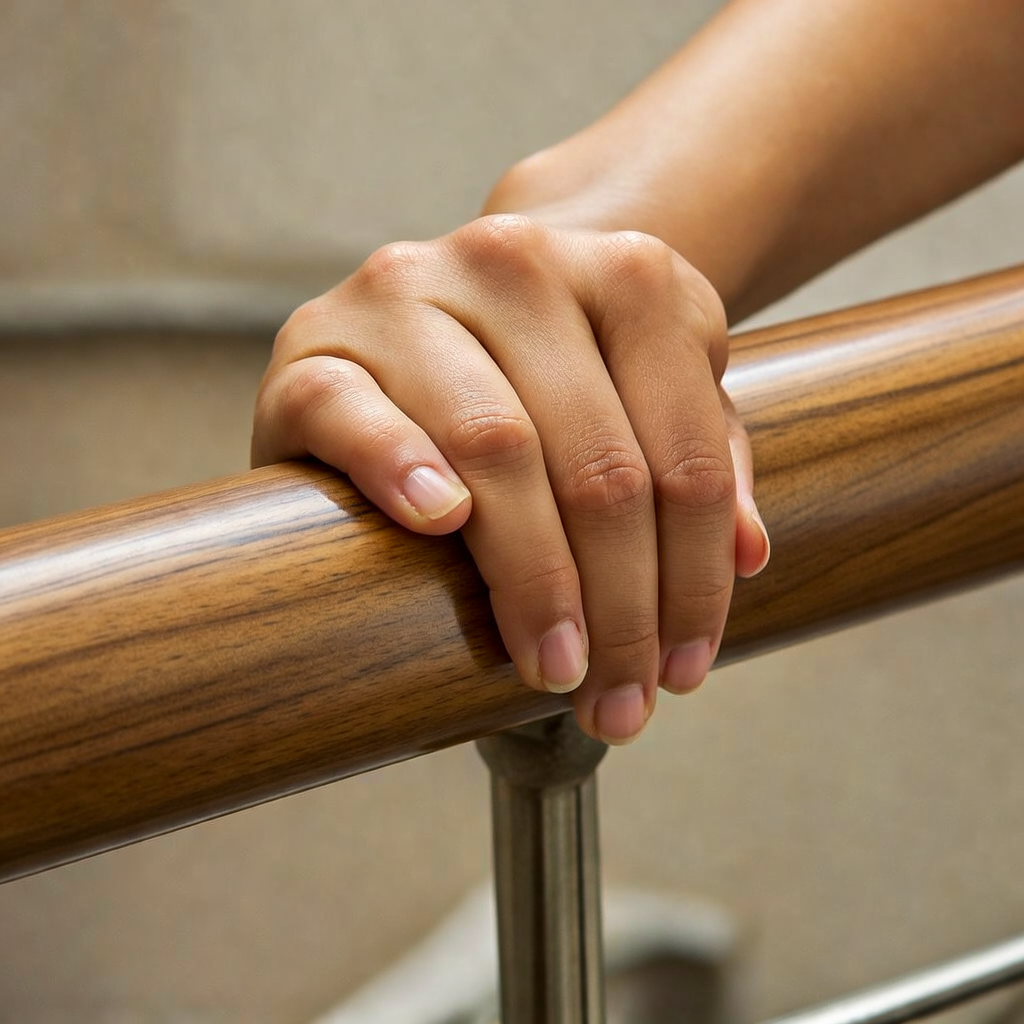
A handrail is only useful if it can catch you when you stumble. If yours has a “wobble,” it’s a liability, not a safety feature.
- [ ] Stability Check: Does the rail move when you apply pressure? Brackets often pull loose from drywall over time.
- [ ] Mounting: Are the brackets secured into wall studs, or just the drywall? (Hint: They should always be in studs).
- [ ] Height: Is the rail between 34 and 38 inches (86–97 cm) from the stair edge? This is the Ontario Building Code standard for optimal grip.
- [ ] Continuity: Can you run your hand down the entire length of the rail without hitting an obstruction?
2. Guardrails & Baluster Spacing
For homes with children or pets, the gaps between the railing posts (balusters) are critical.
- [ ] The “4-Inch Rule”: Can a 4-inch sphere (roughly the size of a large orange) pass between your balusters? If so, the gap is too large and poses a strangulation or fall risk for small children.
- [ ] Guard Height: For railings on landings or open-sided stairs with a drop over 24 inches, the guard must be at least 36 inches high (900 mm).
3. Tread & Riser Uniformity
Your brain relies on “muscle memory” when you climb stairs. If one step is even half an inch taller than the others, you will likely trip.
- [ ] Rise/Run Check: Are all steps the same height (riser) and depth (tread)? Variations over 1/4 inch are a major trip hazard.
- [ ] Surface Grip: Are the treads slippery? Smooth hardwood or polished tile are beautiful but dangerous. Consider clear anti-slip strips or a low-pile carpet runner.
- [ ] Nosing Condition: Is the front edge of the step (the nosing) rounded or sharp? Slightly rounded edges reduce the severity of a fall.
4. Visibility & Lighting
Most stair falls happen on the first or last step because the user misjudged the distance in low light.
- [ ] Dual Switches: Do you have light switches at both the top and the bottom of the stairs?
- [ ] Contrast: Can you easily see where one step ends and the next begins? If your stairs are all one dark wood color, consider adding a contrasting strip to the edge of the top and bottom steps.
- [ ] Glare: Is your lighting so bright it creates “hot spots” or glare on polished surfaces? Use matte finishes or diffused lighting.
5. Aging in Place: The “Accessibility” Audit
If you are modifying a home for a senior, “standard” code is often the bare minimum.
- [ ] Dual Handrails: Are there rails on both sides of the staircase? This provides much better leverage and balance.
- [ ] Landing Depth: Is there enough room at the top and bottom to stand comfortably before starting the climb?
- [ ] Clear Path: Is the stairway free of “temporary storage” like shoes, baskets, or decor? (The most common cause of senior falls).