A Complete Guide for DIY Success
Have you ever ordered a beautiful set of new kitchen doors only to find they don’t quite shut, or worse, overlap your drawers by a fraction of an inch? Few things are more frustrating in a home renovation than a precision error. Learning how to measure cabinet door and hinges is the critical first step in any successful kitchen or bathroom refresh. Whether you are replacing old, worn-out hardware or doing a complete aesthetic overhaul, the difference between a professional-looking result and a DIY disaster lies entirely in your measurements.
In the world of cabinetry, “close enough” simply isn’t good enough. A single millimeter can cause doors to sag, rub against one another, or fail to latch. This guide is designed to demystify the technical jargon—like “overlays,” “cup sizes,” and “boring distances”—and provide you with a foolproof roadmap to accuracy. By the end of this article, you’ll have the confidence and data needed to order your materials with 100% certainty.
Why Knowing How to Measure Cabinet Door and Hinges Matters for DIYers
Before you grab your tape measure, it is essential to understand why precision is non-negotiable. Modern cabinetry relies on tight tolerances. If you are planning a “facelift” for your kitchen, your hinges must align perfectly with both the door and the cabinet frame.
When you master how to measure cabinet door and hinges, you aren’t just getting numbers; you are ensuring the structural integrity of your cabinets. Improperly measured hinges put unnecessary stress on the wood, which can lead to stripped screw holes over time. Furthermore, understanding your measurements allows you to transition from traditional exposed hinges to modern concealed “European” styles, which offer significantly more adjustability and a cleaner, more contemporary look.
Section 1: Identifying Your Cabinet Type
You cannot measure accurately until you know what you are measuring. In North America, there are two primary types of cabinet construction.
Face Frame Cabinets
Face frame cabinets have a wooden frame (usually 1.5 to 2 inches wide) attached to the front of the cabinet box. The doors attach to this frame. This is the most common style in traditional and transitional American homes.
Frameless (European Style) Cabinets
Frameless cabinets are essentially a box with no front frame. The doors attach directly to the inside walls of the cabinet box. These are common in modern, minimalist designs and offer a bit more storage space because there is no frame obstructing the opening.
Section 2: How to Measure Cabinet Door and Hinges for Replacements
If you are keeping your current cabinets but simply replacing the doors and hardware, the process is straightforward but requires a specific sequence.
Step 1: Measuring the Door Dimensions
Always measure the back of the door, not the front. The back is a flat surface and provides a more accurate reading of the actual dimensions.
- Width: Measure from the left edge to the right edge. Record this to the nearest 1/16th of an inch.
- Height: Measure from the top edge to the bottom edge.
- Thickness: Standard doors are usually 3/4″ thick, but verify this, as it affects the type of hinge you will need.
Step 2: Measuring the Cabinet Opening
The “opening” is the empty space where the door sits.
- Measure the width of the opening from the inside edge of the frame to the opposite inside edge.
- Measure the height from the top inside edge to the bottom inside edge.
Step 3: Determining the Overlay
This is where most DIYers get confused. The “overlay” is how much the door covers (overlaps) the cabinet frame once it is closed.
The Pro Formula: (Door Width – Opening Width) ÷ 2 = Overlay.
Example: If your door is 16″ wide and your opening is 15″ wide, your overlay is 1/2 inch.
Section 3: Understanding Hinge Technicalities
Knowing how to measure cabinet door and hinges involves more than just length and width; you also need to understand the hardware’s specific “boring” requirements.
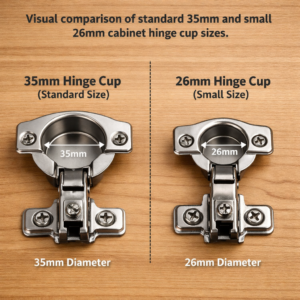
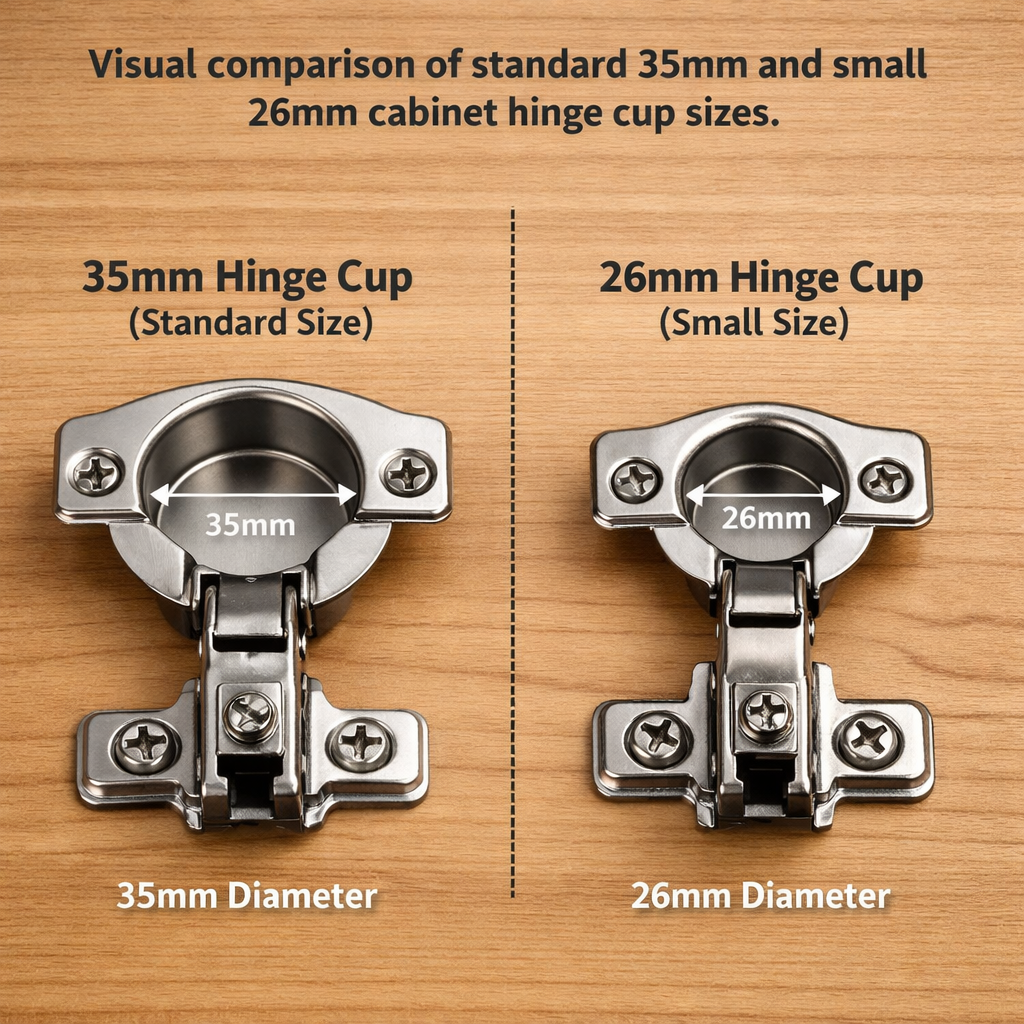
Cup Diameter and Depth
Most modern concealed hinges require a hole (cup) to be drilled into the back of the door.
- Standard Cup Size: 35mm is the industry standard for most kitchen cabinets.
- Small Cup Size: 26mm is sometimes used for smaller vanity or medicine cabinet doors.
- To measure your existing hinges, use a caliper or a metric ruler to measure the diameter of the hole already drilled in your door.
Boring Distance (Tab)
The “boring distance” is the distance from the very edge of the cabinet door to the edge of the 35mm cup hole. Typically, this is between 3mm and 6mm. If you buy hinges with a 5mm boring distance but your doors are drilled at 3mm, the door will not sit flush or may rub against the frame.
Center-to-Center Measurements
For traditional “wing” or “butt” hinges, you need the center-to-center distance between the screw holes.
- Locate the center of the top screw.
- Measure down to the center of the bottom screw.
- This measurement is vital for ensuring you don’t have to drill new holes in your frames.
Section 4: A Step-by-Step Guide to Measuring for New Doors
If you are building new doors or ordering them for an existing cabinet, follow this specific workflow to ensure a perfect fit.
The Measuring Workflow
- Check for Square: Measure the cabinet opening diagonally from top-left to bottom-right, then top-right to bottom-left. If the numbers aren’t the same, your cabinet is “out of square,” and you may need to adjust your door size slightly to compensate.
- Choose Your Overlay Style: * Full Overlay: The door covers almost the entire cabinet frame.
- Partial Overlay: The door leaves about 1/2″ to 1″ of the frame visible.
- Inset: The door sits inside the frame, flush with the front.
- Calculate Door Size: * For 1/2″ Overlay: Add 1 inch to the width and 1 inch to the height of the opening.
- For Inset: Subtract 1/8″ to 1/4″ from the opening width and height to allow for a “reveal” (gap) around the door.
Section 5: Tools Required for Accurate Measurement
To succeed in how to measure cabinet door and hinges, you need the right kit. Household tape measures are often bulky and can lead to errors.
- Steel Ruler: Better for small measurements (like hinges) than a tape measure.
- Digital Calipers: Essential for measuring cup diameters and screw hole distances with sub-millimeter accuracy.
- Combination Square: To ensure your lines are perfectly perpendicular to the door edge.
- Measuring Tape (Fractional): Look for one that explicitly labels 1/8, 1/16, and 1/32 for ease of use.
| Tool | Purpose | Importance |
| Digital Caliper | Hinge Cup Diameter | High |
| Steel Ruler | Overlay & Tab Distance | High |
| Tape Measure | Door Width & Height | Medium-High |
| Notepad | Recording Data | Essential |
Section 6: Common Mistakes to Avoid
Even seasoned pros can slip up. Avoid these frequent pitfalls:
- Measuring only one cabinet: Never assume all your cabinets are the same size. Builders often vary widths slightly to fit a specific wall length. Measure every single door!
- Forgetting the “Gap” (Reveal): If you have two doors that meet in the middle (butt doors), you must subtract 1/16″ or 1/8″ from each door’s width so they don’t hit each other when they close.
- Mixing Metric and Imperial: Many hinges (especially Blum or Grass brands) are engineered in metric. Converting 35mm to inches can lead to rounding errors. If the hinge says 35mm, use a metric ruler.
Frequently Asked Questions About How to Measure Cabinet Door and Hinges
What is the standard hinge size for kitchen cabinets?
The most common “size” refers to the cup diameter, which is almost always 35mm for concealed hinges. For the overlay, 1/2 inch and 1-1/4 inch are the two most common standards in American homes.
How do I measure for hinges if I don’t have the old ones?
You must first determine if you have a face frame or frameless cabinet. Then, decide on your desired overlay (how much the door covers the frame). Once you have the overlay measurement, you can purchase a hinge that matches that specific distance.
How much does it cost to replace cabinet hinges?
Basic hinges cost between $2 and $5 each. High-end soft-close European hinges can range from $8 to $15 per hinge. If you are hiring a pro, expect to pay $100–$300 in labor for an average kitchen.
How long does it take to measure a whole kitchen?
For a standard kitchen with 20–25 doors, a thorough measurement process (including recording all data) will take approximately 60 to 90 minutes. Do not rush this process.
Is it hard for a beginner to measure cabinet hinges?
It is not difficult, but it requires extreme attention to detail. If you can read a ruler to the 1/16th of an inch and understand the difference between a frame and a box, you can do this successfully.
Why won’t my cabinet doors close all the way?
This is usually caused by incorrect overlay measurements or using a hinge designed for a different cabinet type (e.g., using a frameless hinge on a face frame cabinet). Check your “boring distance” to see if the hinge is seated correctly.
What tools do I need to drill for new hinges?
You will need a drill press or a specialized concealment hinge jig (like the Kreg Hinge Jig) and a 35mm Forstner bit.
Conclusion
Learning how to measure cabinet door and hinges is an empowering skill that can save you thousands of dollars in professional contractor fees. By taking the time to identify your cabinet type, calculate your overlay, and verify your boring distances, you eliminate the guesswork that leads to costly errors. Remember: measure twice, record your findings clearly, and always double-check the technical specifications of the hardware you intend to buy.
Now that you have the measurements in hand, the next step is choosing the right style and finish to match your home’s aesthetic. Whether you choose the sleek functionality of soft-close hinges or the classic look of exposed brass, your foundation of accurate measurements ensures the final result will be nothing short of professional.