The $500 Tollbooth: Why Contractor Lead Generation Services Hurt Business
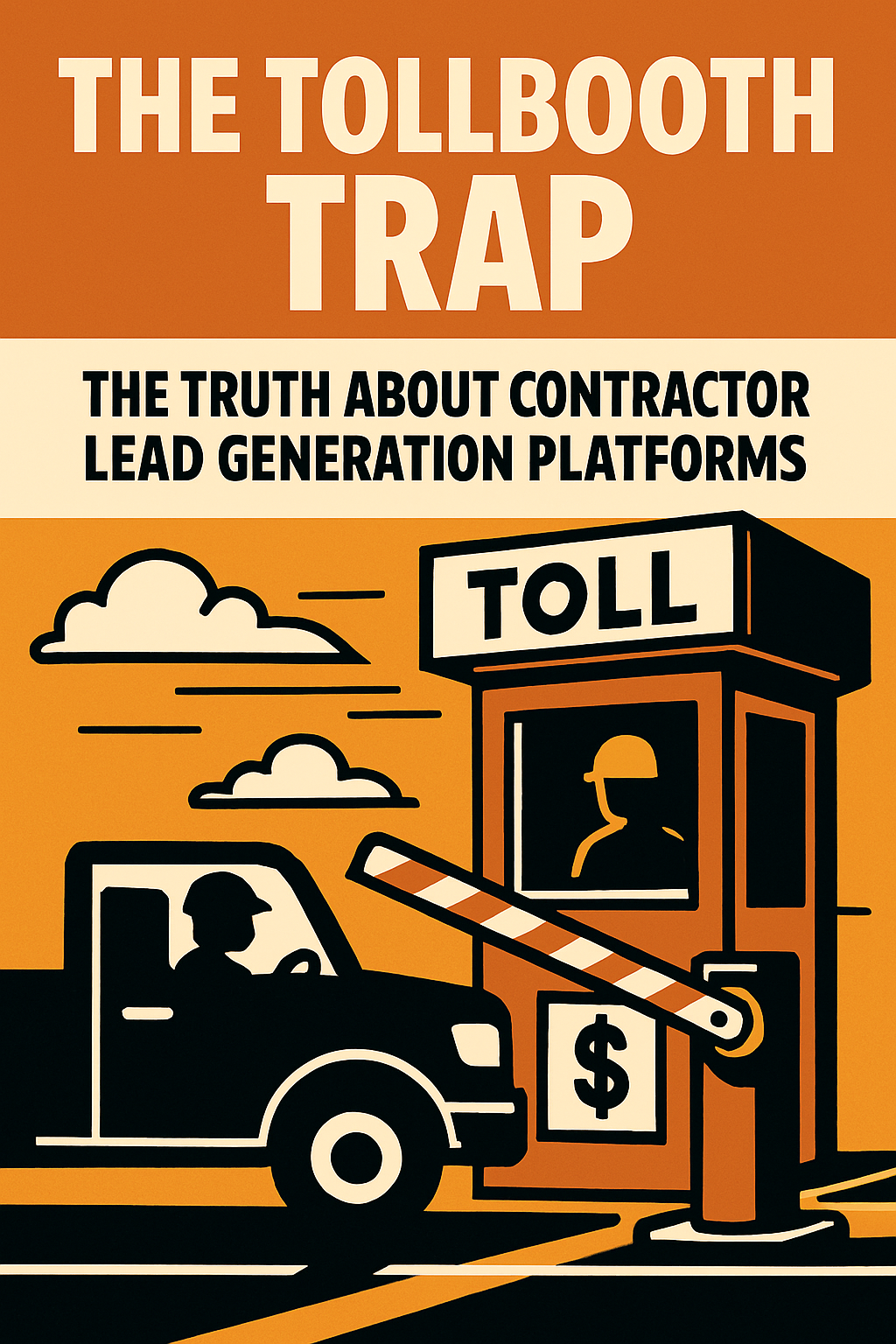
Imagine driving to your local hardware store to pick up supplies for a project. Just before you pull into the parking lot, a stranger stops your car. They demand a $50 fee just to let you drive the last ten feet. They didn’t build the road, they don’t own the store, and they aren’t helping you carry your lumber. They are simply standing in the way.
This is the exact business model used by major contractor lead generation platforms today.
Companies like HomeStars, SmartReno, Houzz, Thumbtack, and TrustedPros present themselves as helpful connectors. They claim to simplify the search for home improvements. However, the reality is far more transactional. These platforms act as digital gatekeepers, positioning themselves between the homeowner and the tradesperson to collect a heavy tax.
In this article, we will expose the “digital tollbooth” model. You will learn how these platforms hijack Google rankings, why they force local businesses to pay exorbitant monthly fees just to be seen, and—most importantly—why this system ultimately lowers value and raises costs for you, the client.
The Digital Landlord: How They Hijack Search Results
To understand why the system is broken, you have to look at how Google Search works. When you search for “plumber near me” or “kitchen renovation,” you typically skip the ads and look at the top organic results.
Ten years ago, those spots were occupied by actual local businesses—the family-owned electric company or the independent roofer. Today, contractor lead generation platforms dominate those top spots. They use massive, multimillion-dollar marketing budgets to buy their way to the top of page one.
The Replacement of the Real Workforce
These companies do not pour concrete. They do not fix wiring. They do not install drywall. Their “product” is search engine dominance. By flooding the internet with directory pages, they push actual local contractor websites down to page two or three of Google—effectively making them invisible to the average homeowner.
Once they have secured the top spot, they turn around and sell that visibility back to the very contractors they displaced. It is a pay-to-play scheme where the platform acts as a digital landlord, charging rent for a space the contractor used to occupy for free.
The Price of Admission: Understanding Contractor Lead Generation Platforms Costs
For a small business or an independent contractor, the financial burden of these platforms is heavy. The “toll” to cross this digital bridge often falls between $600 and $700 a month, depending on the service and location.
Let’s break down how different platforms monetize this tollbooth:
1. The Subscription Model (HomeStars, TrustedPros, Houzz)
Platforms like HomeStars and Houzz operate largely on a subscription basis.
- The Cost: Contractors pay a monthly fee (often $300 to $1,000+) to have a “premium” profile.
- The Trap: If you don’t pay, your profile is buried at the bottom of the list, often below competitors with lower ratings who are paying. You are paying for visibility, not necessarily merit.
2. The Pay-Per-Lead Model (SmartReno, Bark, Thumbtack)
Platforms like SmartReno and Bark charge for the contact information itself.
- The Cost: Contractors pay anywhere from $30 to $100+ just to get the phone number of a potential client.
- The Trap: That same lead is often sold to 3 or 4 other contractors simultaneously. This creates a “race to the bottom” where contractors rush to call first, often annoying the client, while the platform collects fees from everyone.
3. The “Tax” Model (Jiffy, TaskRabbit)
While slightly different, these gig-economy apps set the price for the job and take a percentage cut (15-20%) off the top. This disconnects the client from the business owner entirely, turning skilled tradespeople into anonymous gig workers.
The Homeowner’s Burden: Why You Pay More
You might think, “That’s the contractor’s problem, not mine.” But in economics, costs are always passed down. When a business creates a budget for a renovation, they must factor in their marketing overhead.
If a contractor is paying $700 a month to contractor lead generation platforms to acquire customers, that cost is baked into your quote. By hiring through these intermediaries, you are indirectly funding their marketing departments rather than paying strictly for materials and skilled labor.
The “Middleman Tax” Calculation
Consider a small painting job quoted at $2,000.
- Direct Hire: The contractor’s overhead is low. Most of that $2,000 goes to paint, labor, and profit.
- Platform Hire: If the contractor paid $80 for the lead and pays $600/month in subscription fees, they need to recoup that. They might need to charge $2,200 or $2,300 to make the same margin.
The platform adds zero value to the actual painting of the wall, yet they extract value from the transaction.
The Illusion of Verification and Trust
A common defense of these platforms is that they offer “verified” pros and “trusted” reviews. While there is some truth to this, the system is inherently skewed by money.
The “Top Spot” is For Sale
On many directories, the companies appearing at the very top of the list aren’t necessarily the ones with the highest quality work or the most experience. They are the ones with the largest marketing budget. A mediocre company willing to pay for the “Platinum Package” on Houzz or HomeStars will often outrank a superior craftsman who refuses to pay the toll.
The Accountability Gap
When you hire a brand like Handyman Connection, you are often dealing with a franchise model or a dispatch service. The person showing up at your door is a subcontractor. If something goes wrong, the platform often points to the terms of service that absolve them of liability, while the subcontractor points back to the platform.
When you hire a local business directly, you are speaking to the owner. Their reputation in the community is their livelihood. They have “skin in the game” in a way that a massive tech company never will.
How to Bypass the Gatekeepers
There is incredible value in bypassing the middleman. When you remove the contractor lead generation platforms from the equation, the relationship becomes human again.
For Homeowners: Search Smart
- Scroll Past the Directories: When you Google “electrician,” skip the HomeStars and Yelp links. Look for the actual websites of local companies.
- Use Google Maps: The “Map Pack” often highlights local businesses directly. Read reviews there, as they are harder for platforms to manipulate.
- Ask for Direct Referrals: The best contractors often don’t advertise on these platforms because they are busy enough with word-of-mouth referrals.
- The best value isn’t always at the top of the search results. While the first page is crowded with big-budget commercials, the real value is often found on pages 4 through 7. These businesses aren’t paying for the spotlight—they are earning it. By choosing these companies, you often get the benefit of lower overhead costs and a team that is hungry to deliver high-quality results.
For Contractors: Own Your Traffic
- Invest in Your Own SEO: Instead of renting space on a directory, invest that $700/month into your own website’s content and SEO. Build an asset you own.
- Google Business Profile: Optimize your free Google Business Profile. It is the one place where you can still compete with the giants for free.
- Local Networking: Build relationships with realtors, suppliers, and other trades. These referrals are free and usually higher quality than internet leads.
Frequently Asked Questions About Contractor Platforms
Q: What exactly are contractor lead generation platforms? A: These are third-party websites (like HomeStars, SmartReno, Angi, or Thumbtack) that act as directories. They aggregate lists of contractors and sell the client’s contact information (leads) to the contractors for a fee.
Q: Do these platforms guarantee better work? A: Not necessarily. While they do host reviews, the ranking of companies is often determined by who pays for premium placement, not strictly by skill level.
Q: Is TrustedPros different from HomeStars? A: TrustedPros emphasizes their “TrustScore” algorithm, but the business model is similar. Contractors still pay for premium memberships to get better visibility and access to leads.
Q: How much does SmartReno cost for contractors? A: SmartReno typically operates on a pay-per-lead basis. Contractors purchase the right to quote on a project, competing with other contractors who bought the same lead. Costs vary by project size but can add up quickly.
Q: Why do verified reviews matter if the site is “pay to play”? A: Reviews are still valuable, but you should read them critically. Look for detailed stories rather than just star ratings, and cross-reference the company on Google Maps to see if the reputation holds up across different sites.
Q: Are Handyman Connection and HomeStars the same thing? A: They are slightly different but serve a similar “gatekeeper” function. HomeStars is primarily a directory and review site that sells leads. Handyman Connection operates more like a franchise that subcontracts work to local tradespeople, taking a cut of the profit.
Conclusion
The rise of contractor lead generation platforms has changed the landscape of the trades, and not for the better. They have inserted themselves as a mandatory tollbooth between willing clients and capable workers. By dominating Google search results, they force honest businesses to pay a ransom just to remain visible.
However, the power to change this lies with the consumer. The next time you need a repair or a renovation, try to scroll past the directory sites. Look for the local business websites directly. By making that extra click, you save the contractor from paying the “middleman tax”—a saving that often translates into better service, better focus, and a fairer price for you.